
We hear it every week at the office. And it is false.
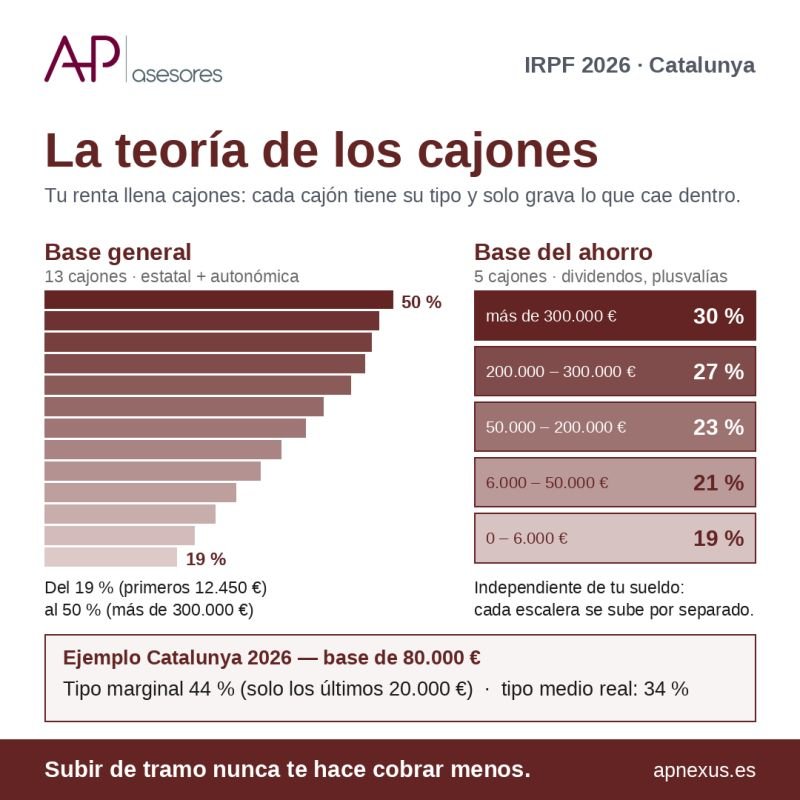
Spanish personal income tax (IRPF) works like a chest of drawers: every euro you earn fills drawers. The first one is taxed at the lowest rate; once it is full, the next euros go into the drawer above, at a higher rate. But full drawers are not touched again: in Catalonia, the first €12,450 of general taxable base are taxed at 19% (9.5% state + 9.5% regional) even if you earn €300,000.
An example with the scale applicable in Catalonia (state + regional)
- General taxable base of €80,000 → gross tax of €27,190.75 (€13,450.75 state + €13,740 regional), before applying the personal and family allowance.
- Marginal rate: 44%. Only the last €20,000 pay it.
- Average rate: 34%.
Nobody pays the marginal rate “on everything”. Confusing marginal and average rates leads to wrong decisions: turning down a pay rise, stopping invoicing in December or giving up extra income for fear of the tax office.
And a detail few people consider: savings income (interest, dividends, capital gains) has its own chest of drawers, from 19% to 30%, independent of your salary. A high salary does not make your capital gains more expensive.
Want to know your real average rate? At AP Asesores we will calculate it for you.
Legislation: state scale, art. 63 of Law 35/2006 on IRPF; regional scale, art. 611-1 of the Catalan Tax Code (Legislative Decree 1/2024), amended by Decree-law 5/2025; savings scale, arts. 66 and 76 of Law 35/2006.